
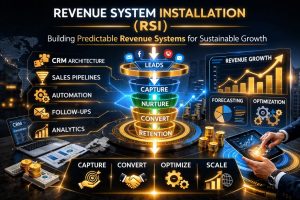
WHAT IS REVENUE SYSTEM INSTALLATION (RSI)? — A COMPLETE GUIDE FOR BUSINESSES
Many businesses today are working very hard.
They are posting online.
Running ads.
Replying messages.
Talking to prospects.
Yet, despite all this effort, sales still feel inconsistent.
Some days are good.
Other days are silent.
One week customers are calling.
The next week, everywhere becomes quiet.
This situation confuses many business owners.
They start asking questions like:
-
“Why are sales not stable?”
-
“Why do people ask questions but not buy?”
-
“Why do leads disappear after showing interest?”
In many cases, the problem is not the product.
It is not even the marketing.
The real problem is lack of a structured revenue system.
This is where Revenue System Installation (RSI) comes in.
What Is Revenue System Installation (RSI)?
Revenue System Installation (RSI) is the process of building structured systems that help a business attract leads, manage prospects, and convert them into paying customers consistently.
Instead of relying on random marketing activities, RSI creates a clear, repeatable process for generating revenue.
Think of it like installing the engine of a business.
Once the system is properly installed, the business no longer depends on guesswork.
Everything becomes organized, measurable, and scalable.
At TELESQUIB, Revenue System Installation is one of our core services, designed to help businesses move from chaotic marketing to predictable growth.
👉 Learn more here:
Why Many Businesses Struggle Without Revenue Systems
Many businesses operate without structure.
Their process often looks like this:
-
Post content online
-
Wait for messages
-
Reply manually
-
Try to convince customers
-
Hope they buy
Sometimes it works.
Sometimes it doesn’t.
There is no system guiding the customer journey.
Because of this, businesses experience:
• Missed leads
• Forgotten follow-ups
• Disorganized conversations
• Wasted advertising budgets
• Unpredictable income
This creates stress for the business owner.
The problem is not effort.
The problem is lack of infrastructure.
The Difference Between Marketing and Revenue Systems
Many people confuse marketing with revenue systems.
They are related, but they are not the same.
Marketing focuses on getting attention.
Revenue systems focus on turning attention into money.
For example:
Marketing may bring visitors to your business.
But without systems:
-
Leads are not captured
-
Conversations are not tracked
-
Follow-ups are forgotten
-
Opportunities are lost
A revenue system ensures that every potential customer is properly managed and guided toward a sale.
Key Components of Revenue System Installation
A strong revenue system usually includes several important parts.
Let’s look at them.
1. Lead Generation
Every business needs a steady flow of potential customers.
Lead generation can come from:
-
Paid advertising
-
Social media
-
Search engines
-
Referrals
-
Content marketing
At TELESQUIB, we use structured digital marketing strategies to attract the right audience.
👉
The goal is not just traffic.
The goal is qualified leads.
2. Lead Capture Systems
Once people show interest, the next step is capturing their information.
This may include:
-
Contact forms
-
Landing pages
-
CRM systems
-
Lead magnets
-
Registration forms
Without proper lead capture, many interested prospects disappear.
Revenue systems ensure every opportunity is recorded and organized.
3. CRM Organization
A Customer Relationship Management (CRM) system helps businesses track all leads and customers.
Instead of conversations being scattered across WhatsApp, email, and DMs, everything becomes centralized.
This helps businesses:
-
Track conversations
-
Monitor customer journeys
-
Assign follow-ups
-
Manage deals
CRM systems are a core part of Revenue System Installation.
4. Automated Follow-Up
Many customers do not buy immediately.
They may need:
-
More information
-
More trust
-
More reminders
Without follow-ups, many sales are lost.
Revenue systems include automated follow-ups through:
-
Email
-
WhatsApp
-
SMS
-
Notifications
This ensures prospects remain engaged until they are ready to buy.
5. Sales Pipeline Management
A sales pipeline shows where each prospect is in the buying process.
For example:
Lead → Interested → Considering → Ready to buy → Customer
With a pipeline system, businesses can clearly see:
-
How many leads they have
-
Which prospects need attention
-
Where sales are getting stuck
This improves conversion rates.
6. Conversion Tracking
If you don’t measure results, you cannot improve them.
Revenue systems include tracking tools that monitor:
-
Leads generated
-
Cost per lead
-
Conversion rates
-
Revenue performance
This helps businesses make smarter decisions.
Why Revenue System Installation Matters Today
Today’s business environment is highly competitive.
Customers have many choices.
Attention spans are short.
Trust takes time to build.
Without systems, businesses lose opportunities daily.
Revenue systems create:
-
Clear structure
-
Better customer experience
-
Faster response times
-
Improved sales performance
-
Predictable revenue
Instead of guessing what works, businesses can measure and optimize their growth.
Who Needs Revenue System Installation?
RSI is useful for many types of businesses, including:
-
Service providers
-
Consultants
-
Agencies
-
Online stores
-
Startups
-
Small and medium businesses
Any business that wants consistent customer acquisition and organized sales processes can benefit from RSI.
How TELESQUIB Helps Businesses Install Revenue Systems
At TELESQUIB, we specialize in helping businesses install structured revenue systems that turn attention into consistent growth.
Our Revenue System Installation service helps businesses:
✔ Generate qualified leads
✔ Organize customer data
✔ Automate follow-ups
✔ Track sales pipelines
✔ Improve conversions
Before installing a system, we often begin with a Revenue System Audit to understand where the business is currently losing opportunities.
👉
This allows us to design the right structure for each business.
Signs Your Business Needs Revenue System Installation
Your business may need RSI if:
-
Leads are inconsistent
-
Customers disappear after inquiries
-
Sales depend heavily on manual effort
-
Conversations are disorganized
-
Marketing results are difficult to measure
These are all indicators that the business lacks proper systems.
The Future of Business Is System-Driven
In the past, businesses relied mainly on hustle.
Today, successful businesses rely on systems.
Systems allow businesses to:
-
scale faster
-
serve customers better
-
reduce stress
-
make data-driven decisions
Revenue System Installation is not just about technology.
It is about building the infrastructure that supports growth.
Final Thoughts
Running a business without systems can feel exhausting.
You work harder and harder, yet results remain unstable.
But when the right revenue systems are installed, everything changes.
Leads become organized.
Follow-ups become consistent.
Sales become predictable.
Growth becomes structured.
And the business owner finally gains clarity.
Ready to Build a Revenue System for Your Business?
If your business is struggling with inconsistent sales, missed leads, or disorganized marketing efforts, it may be time to install a proper revenue system.
👉 Book a strategy call

Let’s help your business move from guesswork to structured growth.
Discover more from Revenue System Installation (RSI) Company | Revenue Infrastructure & Automation Systems : TELESQUIB
Subscribe to get the latest posts sent to your email.